Verkle Trie of Ethereum
Contents
Polynomial
Coefficient representation
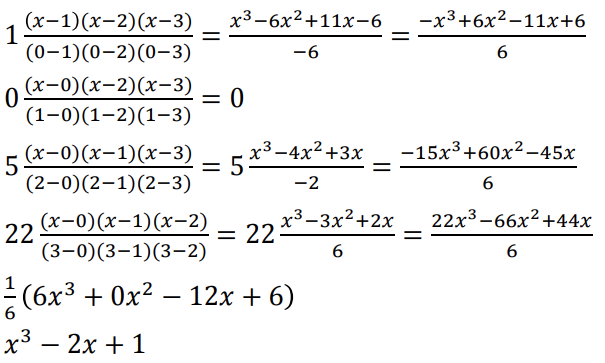
$$f(x) = x^3 - 2x + 1$$
Point-values representation
- (0,1), (1,0), (2,5), (3,22)
Point-values to coefficients
- How many points do we need?
if $d$ is the degree of the polynomial, then $d+1$ points are needed. - How to find the coefficients?
- (method 1) solve the linear equation in $d+1$ variables
- (method 2) use Lagrange interpolation
Reed-Solomon code: Let $d+1$ points be the stored data, and add other $n$ points as the parity data.
Schwartz-Zippel lemma
- For random $x_0$, if I can give the correct evaluation $f(x_0)$, then I know entire information of $f(x)$ (e.g. the all coefficients).
Polynomial Commitment
- Vector to point-value $$(v_0, v_1, \dots, v_n) \rightarrow (0, v_0), (1, v_1), \dots, (n, v_n)$$
- Point-value to $n$ degree polynomial $f(x)$
- Provide the polynomial commitment $C(f(x))$
- Provide a proof $\pi$ for a point $(z, y)$ where $ y = f(z)$
KZG Commitment
-
KZG commitment is a kind of implementation of polynomial commitment.
-
Knowledge -> Point-values -> Coefficients -> Commitment -> Open & Prove & Verify FFT MSM(Multi-Scalar Multiplication) ^ | Trusted Setup-
trusted setup:
- generate a random secret key $s$ (must no one knows) and select a curve and a base point $G$ of it
- generate a set of public points $G, sG, s^2G, \dots, s^nG$ (only generated once and are known to everyone)
-
commitment:
- dervive a polynomial $f(x)=a_0 + a_1x + \dots + a_nx^n$ from the point-values
- dervive the commitment $C = f(s)G = a_0G + a_1sG + \dots + a_ns^nG$
-
open:
- randomly select a point $(z, y)$ where $y = f(z)$
-
prove:
- construct a polynomial $f(x)-y = (x-z)q(x) \Rightarrow q(x) = \frac{f(x)-y}{x-z}$
- derive the proof $\pi = q(s)G = b_0G + b_1sG + \dots + b_{n-1}s^{n-1}G$
-
verify:
- given $G$, $sG$, $C$, $\pi$ and $(z, y)$, check if $$ e(C-yG, G) = e(sG-zG, \pi)$$
- why?
- given $e(aG, bG)=e(G, G)^{ab}$ according to the Bilinear Pairing
- it’s easy to know that $ f(s)-y = (s-z)q(s) $
- then $e(G, G)^{f(s)-y} = e(G, G)^{(s-z)q(s)} \Rightarrow$
- $e((f(s)-y)G, G) = e((s-z)G, q(s)G) \Rightarrow$
- $ e(C-yG, G) = e(sG-zG, \pi)$
-
Notice that $C-yG = (s-z)\pi$. But to calculate $s$ is extremely hard according to the ECDLP (Elliptic Curve Discrete Logarithm Problem).
Verkle Trie
-
Graph
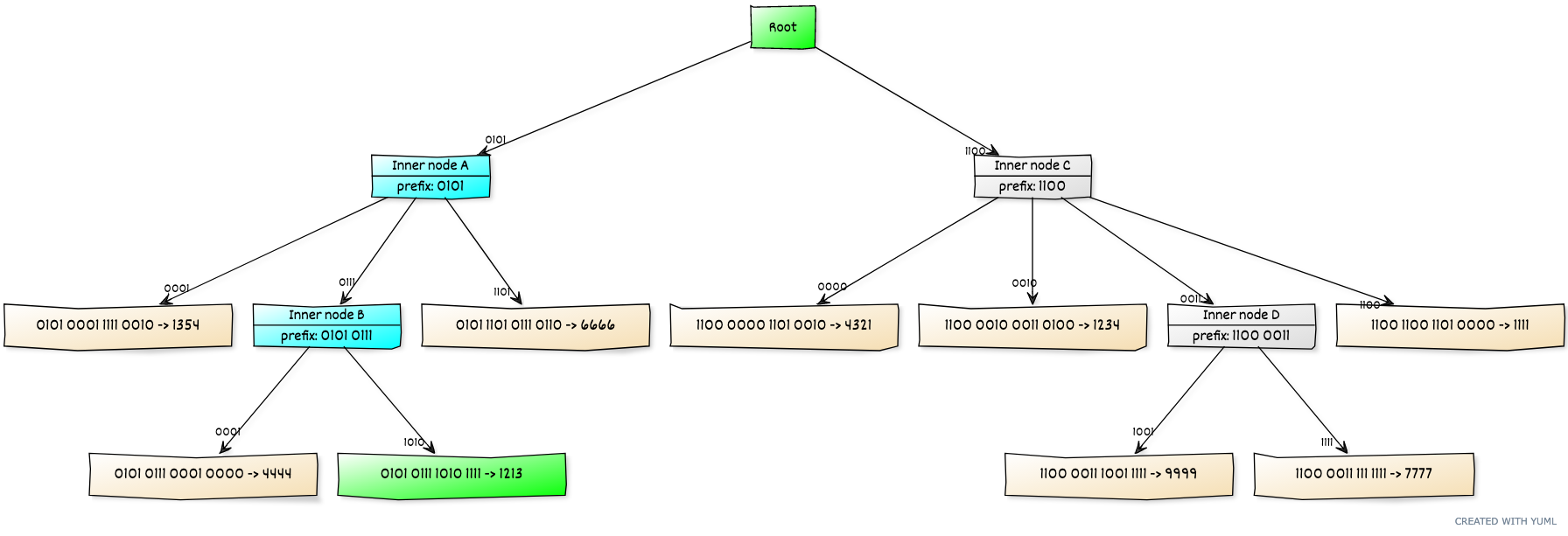
-
How to calculate KZG root:
- KZG commitment for inner node B
- derive point-values $(0, 4444)$, $(1, 1213)$ according to the leaf nodes
- derive polynomial: $f(x) = 4444 -3231x$
- derive commitment: $C_B = f(s)G = 4444G - 3231sG$
- KZG commitment for inner node A and root
- derive point-values $(0, 1354)$, $(1, C_B)$, $(2, 6666)$
- similar to $C_B$, $C_A$ and $C_{root}$ can be derived
- KZG commitment for inner node B
-
How to calculate the opening proof:
- let’s say the path is
root -> node A -> node B -> 4444 - calculate the opening proof along the path: $\pi_{A}$, $\pi_{B}$ and $\pi_{4444}$
- the proof data includes: $(0, 4444)$, $\pi_{4444}$, $(1, C_B)$, $\pi_{B}$, $(0, C_A)$, $\pi_{A}$ and $C_{root}$
- let’s say the path is